Heritage, belonging and South Africa’s unfinished national identity
South Africa is one of those countries the world already thinks it understands. Apartheid, Mandela, 1994, reconciliation, Ubuntu and the Rainbow Nation provide an exceptionally powerful shorthand for our modern history, and none of those ideas is false or unimportant. The difficulty is that they describe South Africa so successfully that they can also become a frame around it, fixing the country at the historical moment when its story became most legible to the rest of the world.
There is something peculiar about continuing to describe a living country primarily through the resolution of a conflict that formally ended more than three decades ago. Apartheid remains fundamental to understanding contemporary South Africa, particularly its spatial inequalities, patterns of ownership, education, wealth and opportunity, but South Africans are no longer only characters in the apartheid and liberation story. We have spent thirty years creating another history, full of accomplishments, failures, new tensions, cultural movements, demographic changes, technologies, institutions, political disappointments, sporting triumphs, new communities and generations with no lived memory of apartheid at all.
This is why Heritage Day interests me less as an annual invitation to display cultural dress, cook familiar food or repeat what we already know about our diversity, and more as an opportunity to ask a harder question about national identity: what makes something unmistakably South African?
The question seems simple until one tries to answer it.
Heritage Day itself began with disagreement
There is an irony in treating Heritage Day as evidence of a fully reconciled national identity because the holiday itself emerged through political negotiation. Before South Africa’s democratic public holiday calendar was established, 24 September was commemorated in KwaZulu as Shaka Day in honour of King Shaka kaSenzangakhona. When the proposed Public Holidays Bill omitted Shaka Day, the Inkatha Freedom Party objected, and the eventual compromise was to establish a national day on which South Africans could recognise their varied cultural heritage. The first national Heritage Day was celebrated on 24 September 1995.
That history is more useful than a sanitised origin story because it reminds us that South African unity has rarely meant the disappearance of disagreement. Our constitutional settlement did not require everyone to arrive at the same understanding of history, identity or belonging. It created a framework within which profoundly different histories could continue to occupy the same political space.
The official theme for the 2026 national Heritage Day celebration is “Celebrating Our Living Heritage: Strengthening the Ties That Bind Us.” The language of “living heritage” is particularly useful because it suggests that heritage is not merely something inherited from previous generations. Living heritage changes as the people carrying it change.
That should give South Africa room to be more culturally adventurous than we sometimes allow ourselves to be.
A country should be allowed to find itself more than once
Countries with deeply entrenched patriotic identities did not develop them through one moment of national consensus. Their identities accumulated through long periods of conflict, reinvention, migration, expansion, social change, cultural argument and generational reinterpretation.
The United States did not settle the meaning of being American at independence. It passed through civil war, slavery and emancipation, industrialisation, waves of migration, segregation, civil rights struggles, wars abroad, profound cultural change and continuing arguments over citizenship and belonging. Britain has spent centuries revisiting monarchy, class, empire, immigration, regional identity and what Britishness means. France continues to contest republicanism, secularism, colonial memory, immigration and national culture. These societies have been given multiple historical opportunities to contradict themselves, reassess themselves and find new ways of understanding who they are.
South Africa should be entitled to the same process without every disagreement being interpreted as evidence that the national project has failed.
That does not mean romanticising conflict or arguing that South Africa needs its own versions of the violence through which older nations were formed. It means recognising that democratic South Africa was never going to arrive culturally complete in 1994. The constitutional settlement established a political beginning. It could not possibly provide the final answer to what Afrikaner identity, Zulu identity, African identity, South African Muslim identity, township culture, immigration, language, citizenship, tradition, modernity or patriotism would mean thirty, fifty or one hundred years later.
A young democracy needs enough confidence to allow those questions to remain open.
There is a strange pressure on South Africa to maintain the moral clarity of its transition as though the country has a responsibility to remain perpetually representative of reconciliation itself. That expectation comes partly from within, but it is also reinforced by the country’s unusual international prominence in the anti-apartheid story. South Africa became globally symbolic before most South Africans had the opportunity to discover what post-apartheid South African culture would actually become.
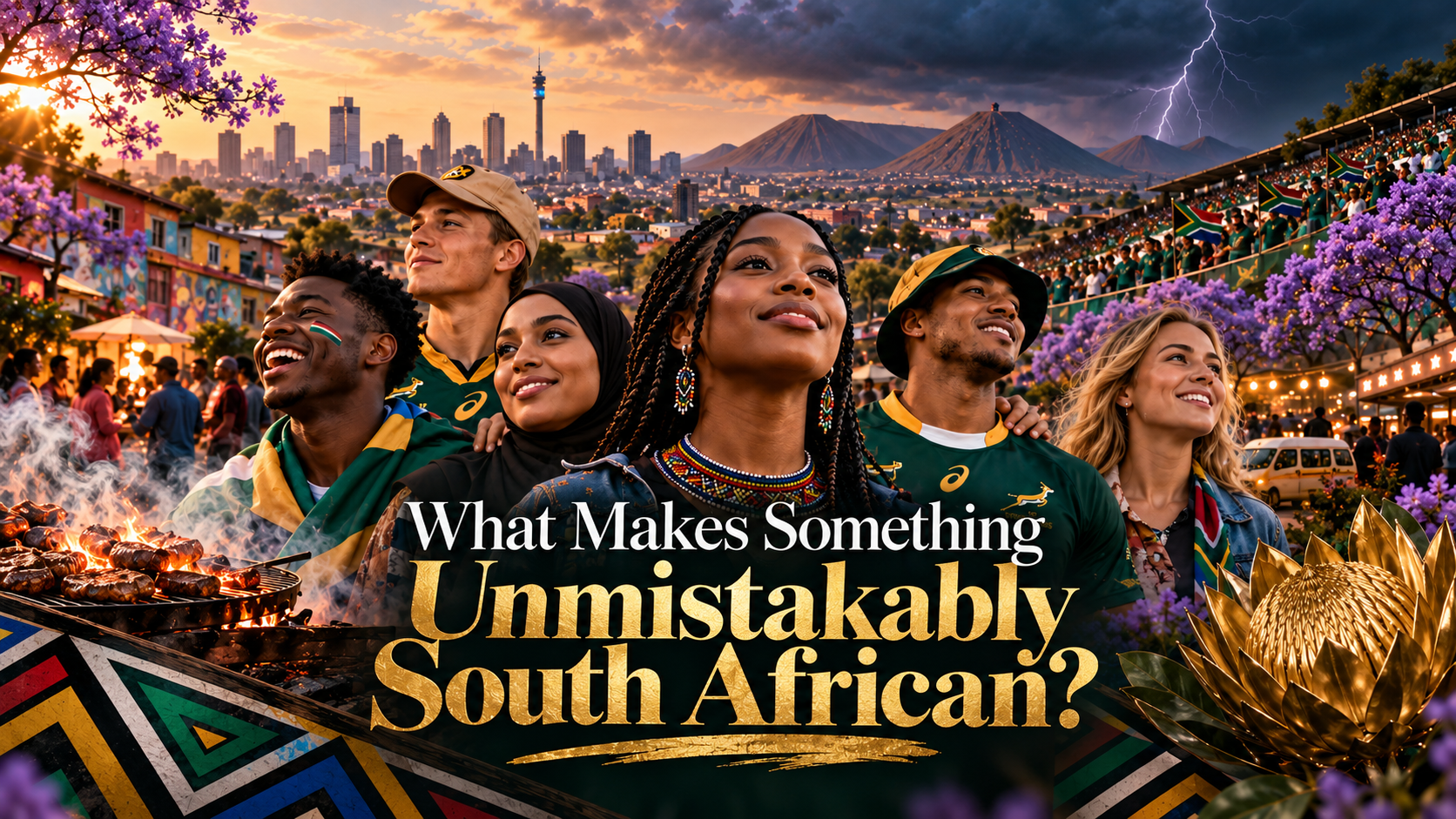
As a result, the version of South Africa presented internationally can sometimes feel carefully curated. It is diverse, reconciled, colourful, politically correct and easily recognisable. Mandela is there. Ubuntu is there. The flag is there. There is often traditional dress, wildlife, a township, perhaps Table Mountain and, if everyone is sufficiently relaxed, a braai.
All of these things belong in the picture. The difficulty begins when they become the boundaries of the picture.
South African culture should be allowed to become specific again
Something becomes culturally powerful when people recognise it without needing an explanation.
A Highveld thunderstorm does not need a government campaign to make it feel South African. Anyone who has watched the afternoon sky over Johannesburg turn almost black, heard the first violent crack of thunder and smelled rain hitting hot ground knows the experience. It belongs to this place through repetition and memory.
The mine dumps of Johannesburg are similarly difficult to separate from the city’s identity. They are simultaneously landscape, industrial residue and historical evidence. Gold created extraordinary economic opportunity and helped build one of Africa’s great cities, while the mining economy was also inseparable from migrant labour, racial exploitation, dangerous working conditions and the economic architecture that helped produce modern South Africa. A mine dump glowing in late afternoon light can be beautiful without requiring us to forget what produced it.
Township skylines contain another version of this contradiction. Many townships were produced by an oppressive spatial system, yet South Africans subsequently generated extraordinary cultural power from those places. Kwaito, amapiano, fashion, political organisation, football culture, street language, entrepreneurship and entirely new forms of urban identity were created within spaces originally structured around exclusion. Heritage is therefore not limited to what our ancestors handed to us. It also includes what people make from the circumstances history hands them.
Then there are the jacarandas. They originated in South America and are not indigenous to South Africa, yet the purple streets of Pretoria and Johannesburg are deeply embedded in local visual memory. Their foreign origin does not somehow cancel the fact that generations of South Africans have incorporated them into their understanding of home. In a country currently wrestling so intensely with questions of migration and belonging, the jacaranda is an unexpectedly useful reminder that cultures, like cities, are constantly absorbing things that began elsewhere.
This does not mean that everything becomes South African merely by arriving here, nor does it make borders, citizenship or origins irrelevant. It simply shows that national culture is rarely as pure as its mythology later suggests. Things travel, settle, change meaning and become familiar. Languages borrow from one another. Food crosses communities. Music refuses ethnic boundaries. Religious practices coexist with older traditions. Children inherit combinations their grandparents might never have imagined.
South African specificity can accommodate that complexity without becoming generic.
The contradiction of belonging in 2026
That proposition is being tested particularly hard this year because questions of immigration and belonging have moved directly into South Africa’s public life.
Large anti-migration demonstrations took place across the country in June 2026, with Reuters reporting widespread fear among foreign nationals and thousands seeking to leave South Africa ahead of planned protests. Subsequent demonstrations led to additional security deployments, while incidents of violence, intimidation and vigilantism intensified a long-running national debate about undocumented migration, unemployment, public services and crime.
These issues should not be flattened into a convenient moral narrative. South Africans are entitled to expect their government to manage the country’s borders, administer immigration competently, enforce the law and explain clearly how migration affects employment, housing, healthcare, education and local economies. A demand for functioning immigration governance is not inherently xenophobic, and pretending otherwise makes an already difficult conversation less useful.
At the same time, frustration with government failure creates a dangerous substitution when citizens begin exercising powers that belong to the state. Deciding who may enter a clinic, removing someone from a home, intimidating a shopkeeper or determining another person’s immigration status on sight moves beyond an argument about border governance. Reports this year have documented deaths, displacement, fear and vigilantism within migrant communities, while authorities have repeatedly warned against citizens taking immigration enforcement into their own hands.
The contradiction becomes especially noticeable in a country that has made Ubuntu one of its most recognisable cultural ideas. Ubuntu is often translated into pleasant language about togetherness and humanity, but philosophies become interesting precisely when circumstances make them inconvenient. The meaningful test is not whether we recognise the humanity of someone who already belongs comfortably inside our idea of community. The test arrives when resources are scarce, public institutions are failing and the person standing beside us is foreign, unfamiliar or perceived to be competing for something we believe should belong to us.
This is where Heritage Month becomes more than a celebration. It becomes an opportunity to examine the distance between the values we associate with ourselves and the country we are actually inhabiting.
Who belongs in the South African picture?
The question of belonging is complicated because South Africa has never been culturally simple.
An Afrikaner family whose ancestry on this continent extends across centuries occupies a different historical relationship with South Africa from a recent immigrant from Zimbabwe. An Indian South African whose family arrived in Natal generations ago has another. Cape Malay communities carry histories shaped by slavery, colonialism, Islam and the Cape. Jewish South Africans, Portuguese South Africans, Greek communities, Mozambican mineworkers, Basotho labour migrants and more recent Congolese, Nigerian, Somali, Ethiopian and Zimbabwean communities each complicate any attempt to describe South Africa as though national identity were an uncomplicated extension of ancestry.
These histories are not legally equivalent, nor should they be treated as interchangeable. Citizenship carries specific rights and responsibilities, and sovereign states require functioning borders. Cultural belonging, however, develops through a messier combination of citizenship, memory, place, language, family, contribution, habit and time.
That messiness is not uniquely South African. It is how national identities develop.
The more interesting challenge is whether South Africa can talk about these distinctions without forcing every conversation immediately into the categories inherited from apartheid. Race remains profoundly relevant, but it is no longer sufficient to describe everything happening here. New questions are entering the national conversation, and South Africans should be able to investigate them with the same seriousness applied to the questions that defined previous generations.
The mythology is already around us
This was the thought that led me back to the original question about what feels unmistakably South African. Not what government declares to be South African, not what tourism advertising selects, and not what an international audience already expects to see, but the accumulated visual, social and emotional signals through which people who live here recognise the country.
Ndebele geometry is one of those signals. It carries a specific cultural history, yet its graphic language can move naturally into architecture, fashion, contemporary design and digital visual culture without losing its source.
Braai smoke is another. The foods, languages, music and social settings around the fire vary dramatically across South African communities, but the ritual of gathering around flame and food travels surprisingly well across race, class and geography. The fact that the braai became attached to Heritage Day was commercially exploited and sometimes criticised, but its persistence also tells us something about the power of ordinary shared rituals.
A rugby terrace offers a different kind of national theatre. Green and gold can temporarily gather people who may have little else in common into one emotional position. Sport does not heal the country’s structural divisions, and expecting it to do so places a ridiculous burden on a game. What it demonstrates, however, is that a shared South African identity can become intensely real without requiring cultural sameness.
That is why I am increasingly interested in the possibility of green and gold extending beyond sport as a broader cultural code for South African excellence. The gold should be actual gold, not merely yellow, because gold itself belongs to the country’s industrial, economic and visual history. Paired with green, it could speak not only about national teams but about the South African scientist, engineer, musician, entrepreneur, artisan, teacher, chef, farmer, designer, athlete or young innovator doing work worthy of national pride.
The idea is not to manufacture another patriotic campaign. It is to recognise that South Africa already possesses a rich visual and cultural vocabulary, much of it hiding in plain sight, and that some of the most powerful signals of belonging are the ones we already recognise instinctively.
The right to remain unfinished
One of the less discussed consequences of South Africa’s international prominence during apartheid is that the country is still frequently viewed from the outside through a moral and political lens. The world learned to understand South Africa through a struggle with unusually clear protagonists, symbols and outcomes, and the democratic transition produced an equally powerful story of reconciliation.
That global recognition is an extraordinary part of our history, but it can become an Achilles heel when South African identity is expected to remain permanently curated around the things that make the country easiest to admire.
A society cannot spend the rest of its existence performing its transition. At some point it has to live, and living involves producing new contradictions, new cultural combinations and new disagreements that cannot always be explained through the vocabulary of 1994. It involves allowing younger South Africans to develop attachments to the country that are not exclusively based on gratitude for liberation. It involves allowing Afrikaners to think seriously about belonging after Afrikaner nationalism, Black South Africans to debate forms of African identity beyond anti-apartheid politics, immigrant communities to negotiate their place in the country, and everyone to argue about what citizenship, contribution and loyalty should mean now.
Some of those arguments will be uncomfortable and some will be badly handled. Some positions will deserve criticism. That is not evidence that the project of South Africa has failed. It may simply be evidence that South Africa has reached the stage where it must begin producing more of its national identity from lived experience rather than inherited political scripts.
We should be capable of holding both the achievement and the incompleteness of 1994 at the same time.
What makes something unmistakably South African?
After all of this, I am less interested in arriving at a neat definition than I was when I first asked the question.
Something feels unmistakably South African when it carries enough accumulated memory, use, adaptation and recognition that people who know this place can locate themselves somewhere inside it. It may be a landscape, a phrase, a colour combination, a sound, a ritual, a smell, a food, a piece of architecture, an attitude or a particular way people behave together.
It does not have to represent everybody, it does not have to be indigenous in the strictest sense, and it does not have to be politically comfortable. The country itself is none of those things.
What matters is that the symbolism emerges from here rather than being assembled merely to explain us to somebody else. South Africa becomes culturally richer when we allow its contradictions to remain visible, when we recognise that heritage can include both inheritance and invention, and when we give ourselves more than one historical opportunity to decide what being South African means.
Heritage Day can be useful in that process, but only if it remains larger than a calendar moment. The deeper work is happening every day as South Africans continue absorbing, contesting, preserving and creating the things that will eventually feel obvious to generations who inherit them.
The national self-portrait is still being painted, and there is no reason to rush its completion. A country this complicated should be allowed the dignity of taking its time.
Leave a Reply